And Then He Said Meme Template
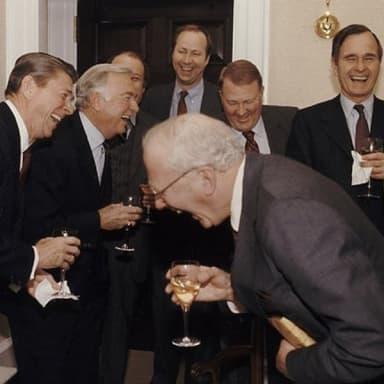
This image is a photograph by Diana Walker of President Ronald Reagan, Walter Cronkite, White House and CBS officials sharing a laugh at the White House on March 3, 1981, after Cronkite’s final interview with a sitting president. The National Gallery of Art identifies the people and occasion. As an image macro, it is catalogued as “And Then He Said” and also circulated under names such as “Laughing Presidents” and “Old Men Laughing.” The recognizable reuse pattern narrates a conversation, then quotes a surprising, foolish, awkward, blunt, or absurd remark; the group’s laughter supplies the reaction. The evidence confirms this specific photo and template listing, but not a single first captioned use or origin for every variant.
Free to try in your browser. Add text, adjust the layout, and download your meme.
Template images may be supplied through third-party sources. Check permission, attribution, and destination-platform rules before publishing. Report a rights or removal concern.
Related meme collections

How to use this meme template
What the And Then He Said meme means
This image is a photograph by Diana Walker of President Ronald Reagan, Walter Cronkite, White House and CBS officials sharing a laugh at the White House on March 3, 1981, after Cronkite’s final interview with a sitting president. The National Gallery of Art identifies the people and occasion. As an image macro, it is catalogued as “And Then He Said” and also circulated under names such as “Laughing Presidents” and “Old Men Laughing.” The recognizable reuse pattern narrates a conversation, then quotes a surprising, foolish, awkward, blunt, or absurd remark; the group’s laughter supplies the reaction. The evidence confirms this specific photo and template listing, but not a single first captioned use or origin for every variant.
A wide photo of several suited men laughing at a White House reception. A white-haired man bends forward in laughter in the foreground while the others grin and hold drinks. The two full-width caption boxes sit above and below the photo.
How the joke works
Slot 1 briefly establishes a normal conversation or topic, commonly with “We were talking about…” or “We were discussing…”. Slot 2 starts “And then he said:” and gives one short, plausible-sounding quote that derails the topic through cluelessness, awkward honesty, absurd confidence, or a sharp non sequitur. The quote is the punchline and should be funny on its own; the laughing group visually reacts to it. Keep setup and quote causally connected enough for the surprise to register, and avoid explaining the joke.
- Top caption: concise ordinary topic or situation that sets up the conversation before the remark.
- Bottom caption: “And then he said” followed by the unexpected, short quoted remark that lands the punchline.
Caption examples
- We were discussing how to make the product easier to use.
- And then he said: “What if we hide the only button?”
The first line establishes a straightforward product discussion; the second is a short, plausible but counterproductive suggestion that explains the group’s laughter.
- And then he said the launch was doomed.
- Everyone laughed at the launch.
The punchline is front-loaded in slot 1, while slot 2 only explains the reaction instead of introducing the quoted remark.
Situations it fits
- a meeting derailed by an unexpectedly blunt comment
- a friend revealing an absurd plan during a serious discussion
- a product or startup conversation followed by a clueless observation
- an awkwardly honest answer to an ordinary question
- a confident non sequitur that makes a group crack up
When this format does not fit
- Do not put the punchline in slot 1 and then explain it in slot 2; the remark itself belongs in slot 2.
- Do not let slot 2 merely repeat or summarize the topic from slot 1; it should introduce a distinct surprising remark.
- Avoid making the quoted remark so random that it has no understandable connection to the setup.
- Do not claim the photograph depicts anonymous businessmen; the catalog image is the identified White House reception photograph.