HOMER BUSH Meme Template
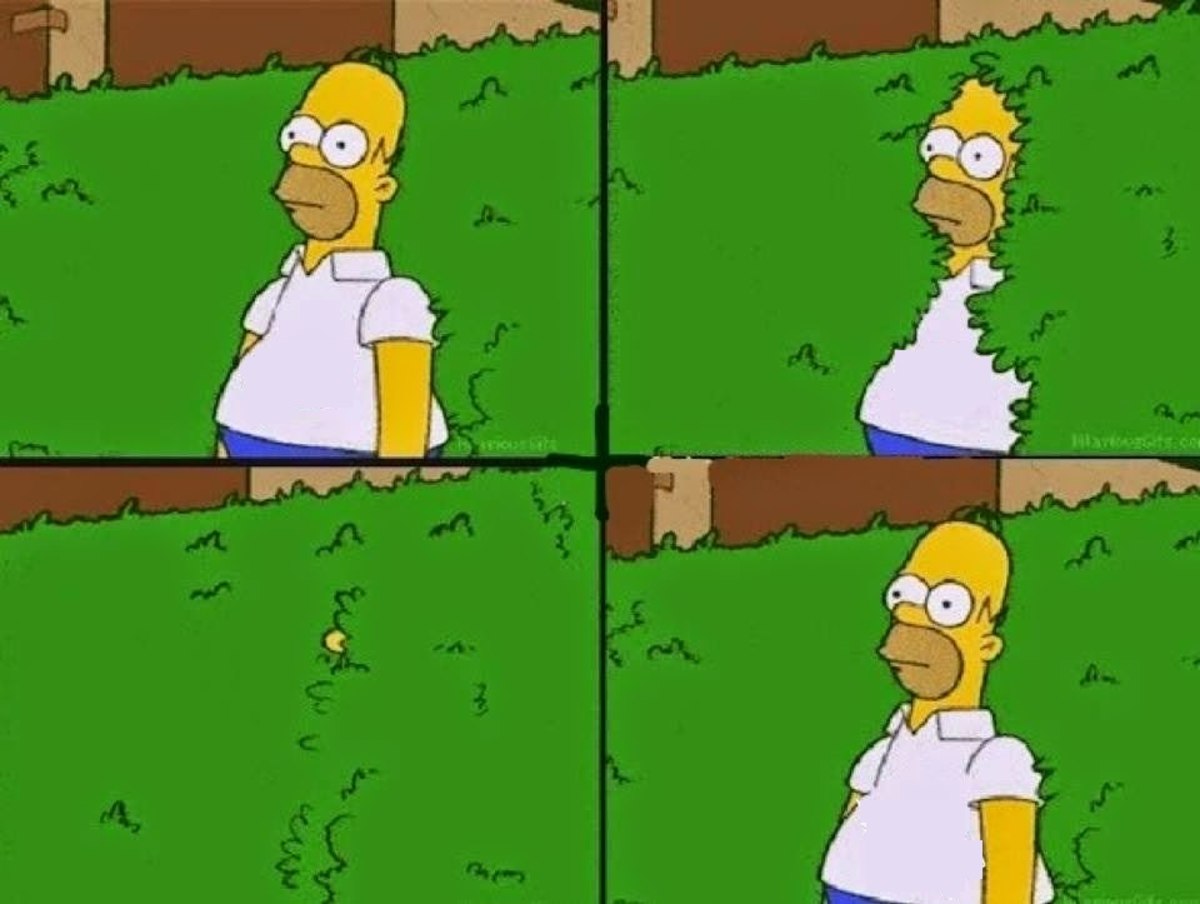
The sequence comes from “Homer Loves Flanders,” a 1994 episode of The Simpsons. In the scene, Homer emerges from Ned Flanders’ hedge to approach and invite the neighbors over; after the interaction, he awkwardly backs into the hedge and vanishes. Know Your Meme documents GIFGarage publishing the retreat as a reaction GIF on December 8, 2010. The familiar animated reaction expresses quietly withdrawing from an awkward, unwanted, or increasingly uncomfortable situation. This specific active collage includes Homer’s visible start, retreat, and return/loop frame, so its three editable labels can play those three moments in order. The source context’s episode/date and GIFGarage details agree with the documented history, though the runtime caption fields map to three visible Homer moments rather than three top/bottom caption lines.
Free to try in your browser. Add text, adjust the layout, and download your meme.
Template images may be supplied through third-party sources. Check permission, attribution, and destination-platform rules before publishing. Report a rights or removal concern.

How to use this meme template
What the HOMER BUSH meme means
The sequence comes from “Homer Loves Flanders,” a 1994 episode of The Simpsons. In the scene, Homer emerges from Ned Flanders’ hedge to approach and invite the neighbors over; after the interaction, he awkwardly backs into the hedge and vanishes. Know Your Meme documents GIFGarage publishing the retreat as a reaction GIF on December 8, 2010. The familiar animated reaction expresses quietly withdrawing from an awkward, unwanted, or increasingly uncomfortable situation. This specific active collage includes Homer’s visible start, retreat, and return/loop frame, so its three editable labels can play those three moments in order. The source context’s episode/date and GIFGarage details agree with the documented history, though the runtime caption fields map to three visible Homer moments rather than three top/bottom caption lines.
The 960×723 collage contains four Simpsons frames in a 2×2 grid. Homer appears in the upper-left frame, backs into and is partly covered by the hedge in the upper-right, disappears entirely from the lower-left, then is visible again in the lower-right as the animation loop resets. No caption text is baked in. The active layout places three caption boxes over Homer’s appearances: slot 1 in the upper-left panel, slot 2 in the upper-right panel, and slot 3 in the lower-right panel; the empty lower-left panel has no text box.
How the joke works
Use the three caption boxes as an ordered mini-story mapped to Homer’s visible positions. Slot 1 (upper-left) sets up the unwanted situation or the reason Homer appears. Slot 2 (upper-right, entering the hedge) states the retreat or decision to disengage. Slot 3 (lower-right, loop/reappearance) gives the return, reset, or new reason he is back. Keep the sequence connected and concise; the empty lower-left panel is a pause with no editable caption. The usual tone is deadpan avoidance or awkward withdrawal, not a literal Simpsons quote recreation.
- Upper-left Homer frame: establish the awkward, unwanted, or increasingly uncomfortable situation that draws Homer into view.
- Upper-right retreat frame: state the quiet decision or action of backing out of that situation.
- Lower-right return/loop frame: show why Homer reappears, resets, or returns after the situation changes.
Caption examples
- ME WHEN THE GROUP CHAT TURNS INTO A TWO-HOUR PLANNING THREAD
- QUIETLY LEAVING BEFORE I GET ASSIGNED A TASK
- COMING BACK WHEN SOMEONE POSTS THE FOOD ORDER
The three captions follow the collage’s Homer-visible, retreating, and reappearing moments in order.
- HOMER
- A GREEN BUSH
- THE SIMPSONS
These are disconnected labels that do not use the ordered movement or make a joke.
Situations it fits
- Leaving a conversation that turns awkward, tedious, or heated
- Quietly exiting a group chat or meeting before being pulled into extra work
- Backing away from an unwanted trend, argument, or social obligation
- Reappearing when the topic changes to something appealing or low-stakes
When this format does not fit
- Do not treat the three boxes as unrelated labels; they should form a readable setup, retreat, and return/reset sequence.
- Do not assign a caption to the lower-left empty-bush panel; there is no active slot there.
- Do not invent dialogue or quote lines as if they were spoken in the episode unless verified.
- Do not make the retreat a recommendation to abandon important safety, caregiving, or work responsibilities.