Hydra Meme Template
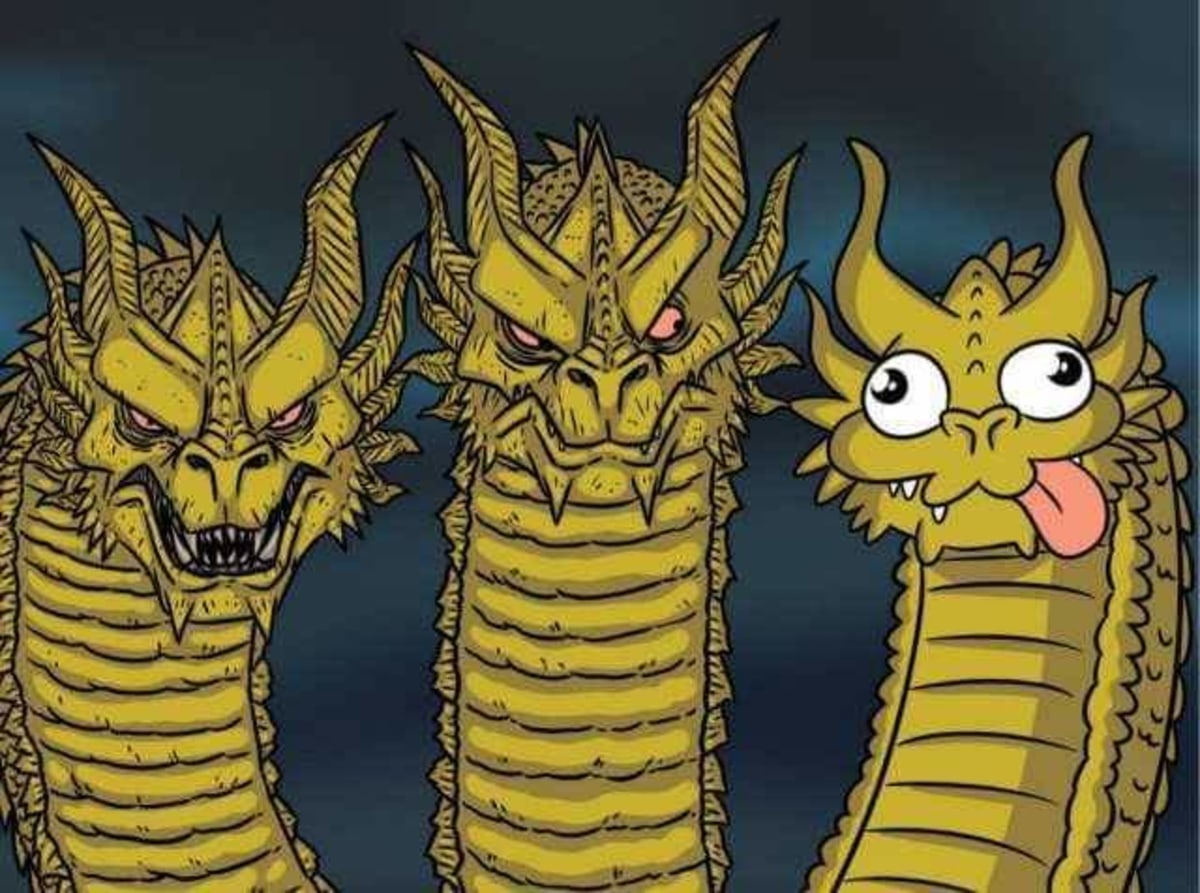
Know Your Meme identifies this artwork as Michael J. Larson’s 2019 fan art “King Ghidorah in a Nutshell,” posted June 2, 2019, and describes the Three-Headed Dragon format as an exploitable/object-labeling meme. The composition commonly uses the three heads as related options, people, attitudes, or approaches, with the goofy-looking head supplying a deliberately silly, clueless, or out-of-step third beat. The supplied Context attributes the art to SammyKaiju; the cited meme-history record instead credits Larson. “Kevin” is a nickname associated with a less serious Ghidorah head in Godzilla: King of the Monsters, but avoid asserting that the goofy head in every crop is the canonically named Kevin: the precise left/right orientation varies, and this asset is fan art. The humor is usually playful self-deprecation or contrast, not a claim that one group is inherently unintelligent.
Free to try in your browser. Add text, adjust the layout, and download your meme.
Template images may be supplied through third-party sources. Check permission, attribution, and destination-platform rules before publishing. Report a rights or removal concern.

How to use this meme template
What the Hydra meme means
Know Your Meme identifies this artwork as Michael J. Larson’s 2019 fan art “King Ghidorah in a Nutshell,” posted June 2, 2019, and describes the Three-Headed Dragon format as an exploitable/object-labeling meme. The composition commonly uses the three heads as related options, people, attitudes, or approaches, with the goofy-looking head supplying a deliberately silly, clueless, or out-of-step third beat. The supplied Context attributes the art to SammyKaiju; the cited meme-history record instead credits Larson. “Kevin” is a nickname associated with a less serious Ghidorah head in Godzilla: King of the Monsters, but avoid asserting that the goofy head in every crop is the canonically named Kevin: the precise left/right orientation varies, and this asset is fan art. The humor is usually playful self-deprecation or contrast, not a claim that one group is inherently unintelligent.
The exact active 640×476 template is a single wide illustration of King Ghidorah with three golden dragon heads: the left head snarls, the center head looks stern, and the right head is wide-eyed with its tongue out. The manual text-box override places one caption over each head (left, center, right); there is no baked-in caption.
How the joke works
Use the three captions as parallel labels for three related choices, people, reactions, or stages. Usually make the first two plausible, competent, or serious and let the visibly goofy third head carry the unexpected, distracted, overconfident, or absurd variant. The captions should share a clear category so the contrast reads immediately. It can also represent three competing inner voices or successive approaches, provided the third label is the comic departure. Keep each label short and independently understandable; do not make one caption depend on a long sentence in another slot.
- Left head: label the first related person, option, reaction, or approach; often a serious or competent one.
- Center head: label the second related person, option, reaction, or approach; continue the shared category or contrast.
- Right, goofy-faced head: land the unexpected, distracted, silly, or self-deprecating variant that completes the three-way comparison.
Caption examples
- THE PLAN I WROTE DOWN
- THE PLAN I TESTED
- THE PLAN I MADE AFTER OPENING 37 TABS
All three are related approaches to planning, with the last escalating into a recognizable self-own.
- MY TEAM’S ROADMAP
- THE CUSTOMER INTERVIEW
- A BANANA IS A PHONE
The labels do not form a coherent comparison or shared situation, so the third head is random rather than a punchline.
Situations it fits
- Two sensible plans contrasted with an improvised or chaotic third plan
- Three people or teams reacting differently to the same familiar situation
- A self-deprecating comparison between one’s organized intention and sillier actual behavior
- Three related product, work, or study approaches where the last one is knowingly absurd
When this format does not fit
- Do not give the three captions unrelated subjects; they need a common category or situation.
- Do not make all three labels interchangeable if the joke depends on a clear contrast.
- Do not turn the rightmost face into a factual claim about the canonical screen position or identity of “Kevin”; treat the position as this image’s visual cue.
- Avoid cruel jokes that target a real person or group as stupid; the format works well for self-deprecation and low-stakes absurdity.
- Keep each caption compact enough to fit over its head without obscuring the face.